
The lens you cannot see
You can think about many things: yesterday’s argument, your plans, the weather. But at any point in your life there are also things you think with. These are assumptions, loyalties, frameworks so close to you that they aren’t visible to you. And that makes them unavailable for inspection. Kegan calls the first kind object and the second kind subject. Object is what you can see; subject is what you see through.
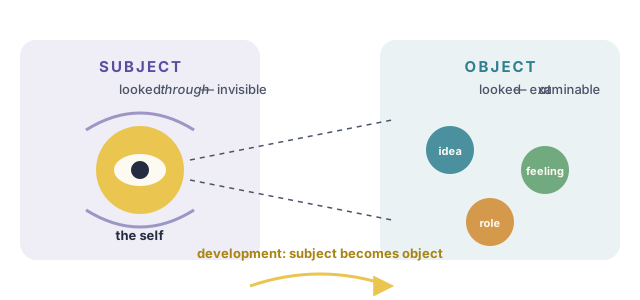
What is object, we can have; what is subject, has us. A teenager doesn’t have a need for peer approval — the need has the teenager. Twenty years later the same person may notice the pull for approval as it arises, weigh it, and sometimes decline it. The need didn’t vanish; it moved from subject to object.
The move that makes a stage
Each Kegan stage is defined by what sits on which side of that line. Development is not learning more facts or acquiring new skills. It is the migration of some whole category of experience from subject to object:
- When impulses become object, the Impulsive Mind gives way to the Imperial Mind: the child now has urges and can defer them in service of its needs.
- When needs become object, the Imperial Mind gives way to the Socialized Mind: the self can subordinate its own agenda to a relationship, because it is now made of relationships.
- When relationships and internalized expectations become object, the Socialized Mind gives way to the Self-Authoring Mind: the self now evaluates expectations against a system of values it authored.
- When the authored system itself becomes object, the Self-Authoring Mind gives way to the Self-Transforming Mind: frameworks become tools, held lightly, plural.
Notice the recursion: the subject of each stage is exactly the object of the next. The thing you were becomes the thing you have. That is why the stages form a strict sequence — you cannot hold your ideology at arm’s length (Stage 5) before you have an ideology of your own to hold (Stage 4).
Why transitions hurt
Because subject is what the self is, moving something to object is experienced as a partial death of the self. The Stage 3 person beginning to question their community’s expectations doesn’t feel like they are gaining a skill; they feel like they are betraying everyone they love, or losing themselves. Transitions take years, often arrive via crisis, and have long stretches where the old meaning-making no longer works and the new one isn’t yet trustworthy. Kegan’s deepest practical point is that people in transition need both confirmation of who they are and challenge toward who they are becoming.
What the stages are not
The stages are not intelligence, virtue, or rank, and most everyday behavior won’t tell you anyone’s stage. These caveats matter enough to get a full page. Likewise, the stage numbers do double duty as a pattern vocabulary that floats free of developmental claims, which is covered in Stages & Patterns.
The short version: a stage is defined by what you can’t see because you’re seeing with it. Growth is the repeated discovery that your lens was a thing (“I was blind to the Matrix before but now I see!”) and the quiet construction of a wider lens behind it.