
Overview
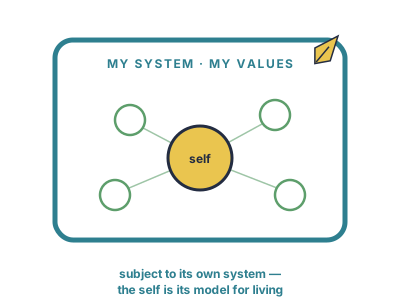
The Self-Authoring Mind has done something remarkable: it has stepped behind the web of relationships and expectations that was the self at Stage 3, and built a place to stand. From there it composes an identity of its own. This is made up of values, principles, long-term purposes, a theory of who it is. It then uses that system to decide which expectations to honor and which to decline.
This is the stage modern professional life keeps asking for. The Self-Authoring Mind can take criticism of its work without bleeding, because the work is evaluated against its own standards rather than against the critic’s approval. It can disagree with a mentor and keep the relationship. It can hold an unpopular position alone. Where the Socialized Mind asks what do they expect of me?, the Self-Authoring Mind asks what does my system require? and notices that those answers sometimes differ.
Its limit is the same shape as every stage’s limit: what it cannot see is what it sees with. The authored system itself is subject. The Stage 4 self defends its framework at the border, experiences fundamental challenges to its ideology as attacks on its person, and tends to mistake its one well-built map for the territory. The strength — coherence — is also the wall.
Subject — what it is
Its own ideology, identity, and system of values. The frame is invisible because everything is seen through it.
Object — what it has
Relationships, others’ expectations, inherited values which are now weighed against the authored system rather than constituting the self.
What it looks like
- An inner seat of judgment. Feedback is information to evaluate, not a verdict on the self.
- Strong boundaries. As in, the ability to say no to one’s own community and survive it.
- Coherent long-term commitments that don’t require external scaffolding to maintain.
- A characteristic blind spot: ideological rigidity, and impatience with frameworks that don’t fit its own.
Stage 4 as a pattern
As pattern language, “4-patterned” names systematic, principle-first behavior wherever it appears: writing the decision memo with explicit criteria, refactoring the mess into one consistent architecture, holding the line on a policy because the policy is the point. Institutions can be strongly 4-patterned with constitutions, codebases, and audit trails, regardless of the stages of the people inside. And a person who is natively 4 can still spend a 3-patterned evening with their family. Using the lower pattern can be a choice rather than a regression.
The move beyond
For most people who reach it, Stage 4 is the destination. For a few, usually after years of running a system into its own edge cases — watching it work brilliantly here and fail strangely there — the system itself begins to migrate from subject to object. The system doesn’t get abandoned altogether, but it becomes held and wielded like a hand uses a pen to mark paper. When you can hold your own ideology as one good map among several, and move between maps without losing yourself, you have crossed into Stage 5, the Self-Transforming Mind.